

According To The Data In Model 1 How Many Females
Who are single moms today?
In summary, there are more single-parented headed households today than any other time in recent history. The majority of those families are headed past a single mom. In fact, 64% of millennial moms have a child outside of marriage, according to Johns Hopkins researchers.
The reasons for these chop-chop changing statistics include high — but declining — divorce rates, simply more significantly, a drib in marriage rates overall amid young people in the U.s., and an overall acceptance for having children outside of a "traditional" heterosexual, first union.
There are 1.ii million divorces in the United states each year.
Traditional nuclear families with two married heterosexual parents are now the minority of U.S. The ascent of single motherhood is the largest influence on this trend — followed past multigenerational families, blended families, adoptive and foster families, and famililes headed past aforementioned-sex parents.
A total 46% millennials and 44% GenXers say "marriage is becoming obsolete."
This post has recent stats on single-parent headed homes and their children, but also sheds light on the nuance of the surge in unmarried parenthood and wedlock, as well as equal co-parenting.
Contents
- 1 Single mom statistics
- 1.i Millennial single mom statistics
- ane.2 Gen Z unmarried mothers statistics
- 1.iii Older single mom statistics
- 2 Single motherhood charge per unit past race
- iii Single mothers' statistics: Pedagogy and income
- 3.1 Single motherhood pay gap
- three.2 Unmarried mothers on food stamps and public assistance
- four Single parents past country
- iv.one Children in single-parent families by race in the Usa
- 5 Single moms are overwhelmingly doing information technology all alone
- 6 Challenges of single-parent families
- seven Takeaways from these unmarried mom statistics
- 7.1 There are more single moms because information technology is more acceptable to be a unmarried mom
- 7.2 More than gender equality at abode — including in separated families
- vii.three Millennial moms are more comfy with being a working parent
- 7.four More reading:
- seven.five Related documentary and books on shared parenting:
- seven.half dozen According to the Data in Model i How Many Females
Single mom statistics
There were 15.6 one thousand thousand single mother-headed households in the Us in 2022. This is 3x the number in 1960. In addition:
- 25% of U.S. families are headed by a single parent, and fourscore% of single-parent headed households are moms — or 21% of U.S. children alive primarily with a unmarried mother, co-ordinate to Census data.
- Studies estimate that past the time children plow 9, 20% of U.S. children built-in to a married couple and more than l% of those born to a cohabiting couple volition experience the breakup of their folks.
- 40% of babies born in the United States were born to an unmarried mom in 2022, according to demography data.
Millennial single mom statistics
Per Johns Hopkins University researchers paper, "Changing Fertility Regimes and the Transition to Adulthood: Testify from a Recent Cohort:"
- 57% of millennial parents had at least ane child out of wedlock.
- 64% of millennial moms reported at to the lowest degree 1 birth out of wedlock.
More educated millennials are having babies exterior of marriage. Of millennial moms who take babies outside of marriage, 67% accept some higher teaching, and 32% have iv or more than years of college didactics.
While the two.1 million unmarried mothers in college in 2012 is double that of 2000, according to an Institute for Women's Policy written report, the graduation rate of women who entered college as a mom is merely 28% for single moms, compared with 40% percent of married moms, and 57% of female students who were not parents.
There is a stark division between single millennial moms who have higher degrees and those who do not:
- 71% of millennial moms with a four-year college caste were married, and typically were in their 20s when they starting time gave nativity.
- 74% of millennial moms without a available'southward degree were unmarried, and typically had children younger.
Throughout history, wedlock and parenthood have been linked milestones on the journey to adulthood.
Only for the young adults of the Millennial Generation, these social institutions are condign delinked and differently valued.
Today's xviii- to 29-twelvemonth-olds value parenthood far more than than marriage.
Gen Z single mothers statistics
Generation Z — children built-in in the mid to late 1990s to early 2010s — are mostly descendants of Gen X.
According to an commodity by the Annie E. Casey Foundation, Gen Z women were:
- More likely to be unmarried when having a baby — numbers increased from 33% to forty% between 2000 and 2022
- More than likely to graduate from high schoolhouse and pursue college education
According to Pew Research Centre, Gen Z are poised to exist the best-educated generation to date. As of 2022, 57% were enrolled in 2- or 4-year colleges compared with 52% of Millenials in 2003 and 43% of Gen Xers in 1987.
In 2022, 44% of Gen Z, ages 7 to 17 were growing up with a parent who graduated with a bachelor's degree or pursued higher education.
A 2022 Forbes article asserts that Gen Z women are delaying maternity in favor of work and a desire to have a flexible life with protected time just for themselves.
This could be because Gen Zers were more likely to have been raised by a single parent, co-ordinate to The Survey Center on American Life.
Older single mom statistics
Today, there are far more older mothers overall, including more older single moms.
By comparison, there has been a 70% drop in teen births — from 62% of girls anile 15-19 in 1991, to 19% in 2017, the most recent data provided past the Department of Health and Human being Services.
- 48% increment in births to unmarried women anile 35-39 (2007-12)
- 29% increase in births to single moms aged 40-44
- 55% of never-married women ages 40 to 44 have at least ane child, up from 31 per centum 2 decades ago, co-ordinate to Pew's assay of Demography information.
While the rate of babies built-in to single mothers has declined slightly, there is a notable rise in babies born to single moms by option – women who tend to be older, more educated, and with college income.
Single motherhood charge per unit by race
Single mother numbers in the United States take ever been college among African American women. At the hands of slavery, black women's consensual relationships and marriages diameter no legal rights, and black women had no legal rights to the children they diameter at the hands of rape of their white slave owners.
Per Pew:
"Once largely express to poor women and minorities, motherhood without union has settled deeply into middle America.
The fastest growth in the concluding two decades has occurred among white women in their 20s who have some college didactics but no four-yr degree. Among mothers of all ages, a majority — 59 per centum in 2009 — are married when they have children.
Simply the surge of births outside marriage among younger women — nearly ii-thirds of children in the United States are born to mothers under xxx — is both a symbol of the transforming family and a hint of coming generational change."
"Single parent households exist in a different socioeconomic pool than married households.
Single mothers earn incomes that place them well below married mothers in the income ladder.
According to Pew, married mothers earned a median family income of $80,000 in 2011, almost iv times more than than families led past a single mom.
This is probable a consequence of the lower educational qualifications of single mothers, as well every bit the fact that they are younger and more likely to be black or Hispanic. Married mothers tend to exist older and are disproportionately white and college-educated."
| Single mothers by race and percentage | |
| Percentage of white unmarried mothers | xl% |
| Percentage of single black mothers | xxx% |
| Per centum of Hispanic unmarried mothers | 24% |
| Percentage of Asian single mothers | iii% |
Single mothers' statistics: Educational activity and income
Of millennial moms who have babies exterior of marriage, 67% accept some college education, and 32% take four or more years of higher education.
What percent of unmarried mothers live in poverty?
- 32% of single moms earn $40,000+
- 10% of single moms earn $fourscore,000+
A Pew Inquiry Center analysis found the poverty rate by household caput was:
- thirty% of solo mothers
- 17% of solo fathers
- 16% of families headed by a cohabiting couples
- 8% of married couple families
From the written report:
Cohabiting parents are younger, less educated and less likely to take e'er been married than solo parents. At the same fourth dimension, solo parents take fewer children on boilerplate than cohabiting parents and are far more than probable to exist living with ane of their own parents (23% vs. 4%) …
Solo moms are more twice as likely to be black as cohabiting moms (thirty% vs. 12%), and roughly four times equally probable equally married moms (7% of whom are blackness). 4-in-ten solo mothers are white, compared with 58% of cohabiting moms and 61% of married moms.
At that place are well-nigh no racial and ethnic differences in the profiles of solo and cohabiting fathers.
Unmarried maternity pay gap
Mothers overall suffer a pay gap of 29%, earning an average of 71 cents for every $1 earned by a dad — or an average of $16,000 less per year, according to the National Women's Law Center.
This motherhood penalty is dramatically worse for single mothers at 35%. According to Pew Research, unmarried moms with a household of three earn just $26,000 per year on boilerplate, compared with $40,000 per yr for single dads.
I conducted a survey of 2,279 single moms and found a direct correlation between fourth dimension-sharing between single parents, and single moms' include. The 2022 white paper outlining the findings of the Unmarried Mom Income and Fourth dimension-Sharing Survey are hither:
Survey highlights:
- Moms with 50/l parenting schedules are 54% more likely to earn at to the lowest degree $100,000 annually than moms whose kids are with them most of the fourth dimension (with "visits" with the dad), and more than 3 times (325%) more likely to earn $100,000+ than single moms with 100% fourth dimension responsibility.
- Moms with 50/fifty parenting schedules are more than twice as likely to earn $65,000+, and nearly 3-times as probable to earn that sum than moms with 100% parenting time.
- 13% of unmarried moms accept a 50/50 parenting arrangement, and 51% take their children 100% of the fourth dimension.
- ix in ten single moms say they could earn more coin if they had more equality in their co-parenting schedules.
- Moms with 50/l parenting time are 34% more than likely to say they feel "awesome and proud" of being a mom when compared with moms who care for their kids 100% of the time.
More details about the survey project.
I also founded Moms For Shared Parenting, an system devoted to advancing parenting policy and civilization.
Single mothers on food stamps and public assistance
In that location were 15.half dozen million children living in single mother-headed households in the Usa, according to U.S. Census data.
- About 5.five million children lived below 100% of poverty
- Near 7.1 million children were in the food stamp program
- Roughly ane.ane meg children were in single-mother families that received public assistance
Unmarried parents by country
A December, 2022 Pew Research Heart study of 130 countries and territories finds the United States has the world's highest charge per unit of children living in single-parent households, at 23%. By comparison:
- Russia 18% of children live in unmarried parent-headed households
- Uganda 10%
- Germany 12%
- Japan 7%
- Mexico 7%
- India 5%
- China four%
- Worldwide: an average of seven% of children nether historic period xviii live with a single parent
Children in single-parent families by race in the U.s.
According to the virtually contempo U.S. census information, these are the percentages of children per race in single-parent homes:
- American Indian – 52%
- Asian and Pacific Islander – 15%
- Black or African American – 64%
- Hispanic or Latino – 42%
- White (Non-Hispanic) – 24%
- Two or more races – 40%
Unmarried moms are overwhelmingly doing it all lone
- 50% of custodial parents have kid back up agreements (informal or formal), only only 44% received all child support owed, according to a 2022 U.S. Census Bureau study.
- The median sum due is well-nigh $480 per calendar month.
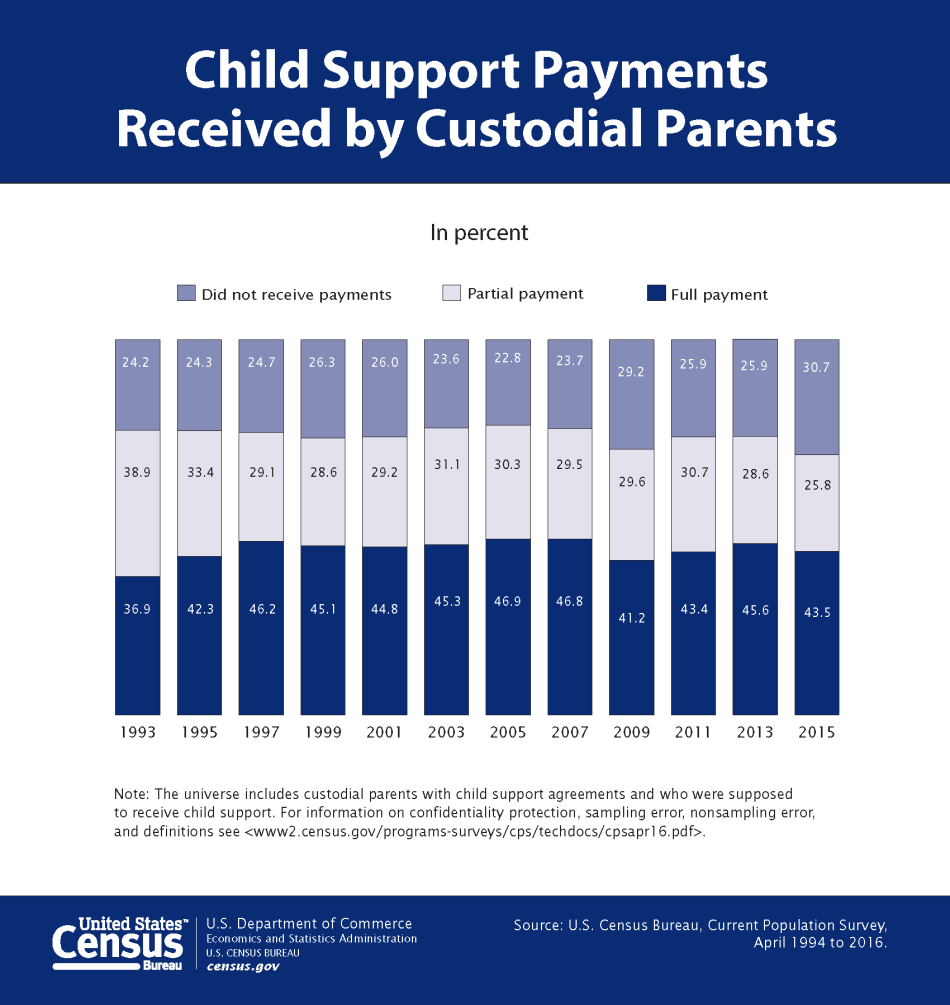
- Of fathers who alive autonomously from their children, 22% of dads encounter their kids more than one time per week.
But, how many of those fathers choose not to see their kids more, and how many of them are forced out their kids' lives completely, or marginalized to a weekend dad?
The answer to this question is complicated and hotly debated. A sexist culture and family court system that marginalizes fathers is a real force, equally is parental breach, mass incarceration of African American men are all existent forces.
Challenges of unmarried-parent families
Children in single-parent families are more likely to face challenges stemming from the breakdown of their parents.
Co-ordinate to an article by the Annie Due east. Casey Foundation, over 50% of children built-in to cohabiting couples will experience a parent leaving the home. And 20% of children whose parents are married will experience a divorce by the fourth dimension they plough ix years former.
This equates to a disruption in routines, living spaces, educational activity, and household income.
For divorcing couples, parenting classes are a bang-up showtime-step to restoring stability for children in the midst of a split. Learning how to co-parent is essential to better outcomes for children of divorce.
Every bit research continues to evolve on this topic, several factors are clear: children excel in stable, safety nurturing environments where their emotional and concrete needs are met.
Takeaways from these unmarried mom statistics
In that location are more single moms because it is more acceptable to be a single mom
Single moms are growing in number, in part, because women have more financial opportunities, and can more comfortably afford to have children without the full-time fiscal support of the children'south father. At the same time, the rise in single motherhood has severely lessened the stigma of being an unmarried mom, a fact that has been attributed to the drib in ballgame rates in contempo decades.
The rise and general credence of single maternity across all demographics (young, African American and Hispanic moms make up the majority of this trend, but older, more affluent single-moms-by-selection is the fastest-growing segment of the unmarried-mom population), is role of a larger trend of redefining what family and healthy family ways. It was a few years ago that headlines appear that the married, heterosexual parent household with children is now the statistical minority in the United states of america. Today, about a quarter of married couples who live with children under historic period 18 are in these Leave it to Beaver families where only the father works — downwardly 47 percent in 1970.
How to be a successful unmarried mother
While gay, multi-generational, composite and adoptive families are on the rise, unmarried-mom-led households fabricated upwards the bulk of that new majority of "non-traditional" families (enter centre-rolling of many, including this author!). Paired with news that young adults increasingly find spousal relationship an obsolete institution, this made sense. However, this new acceptance of family does not foreclose romantic partnerships, as most Millennial moms are in committed romantic partnerships, fifty-fifty if they are non legally married.
From "Why Is The Abortion Rate Falling?" in The Atlantic:
"When marriage was the near-universal norm in American society, a pregnancy out of wedlock pushed a couple toward one of four choices: shotgun wedding; adoption; abortion; or single motherhood, in that order of social acceptability.
The event was a order in which both abortion and single motherhood were rare.
In the decade subsequently 1965, both women and men claimed greater sexual autonomy for themselves. The shotgun wedlock seemed an increasingly outrageous imposition to come across increasingly irrelevant social expectations. After 1970, adoption of native-born American children past not-related parents apace dwindled. Yet outright unmarried motherhood remained comparatively unusual for middle-class Americans, and particularly for white middle-course Americans. The abortion spike between 1975 and 1990 reflected a new ranking of acceptable responses to an unmarried pregnancy: abortion, single parenthood, shotgun wedding, and adoption, in that gild."
More gender equality at home — including in separated families
Today's expectations of the role that men and women volition play in parenting is different from older moms. Millennial mothers are virtually probable to have children with men who are more inclined to share household and childcare duties. To wit: a 1982 report found 43 percent of fathers never changed a diaper. Past 2000 another report showed this figure had fallen to 3 percent.
Fatherhood, as we know, goes far across keeping little butts clean. While the bulk of care of children still falls on women, a Boston Higher Centre for Work & Family study found that 66 percent of Millennial dads believe that child care should be shared equally (even if just 29 percent conceded that that work is actually shared as in their family unit), and the number of hours dads today spend with their kids tripled to vii hours weekly in 2015 from 1965, while they spend an boilerplate of nine hours on housework, up from 4 hours one-half a century earlier.
These trends are reflected in separated families, where the number of hours that dads spend with children has increased regardless of whether the dad is a office of the aforementioned household. While in 80 percent of custody cases, courts rule to give mothers chief residence, there is a huge new motility towards shared parenting, in which it is presumed that both parents take equal legal custody and approximately half time with each parent in the effect of a separation. In fact, in 2017 alone, shared parenting legislation has been introduced in 25 states, and counting. This makes sense, as at that place are 60 peer-reviewed studies that detect that shared parenting — in which each parent has the kids about 40 percent of the time — is all-time for children.
Shared parenting is also great for moms. After all, if with more parenting and fourth dimension support from another parent means more fourth dimension to nurture other parts of your life — including your career. After all, we tin't have equality at work if we don't have equality in your family — regardless of what your family looks like.
Related: Shut the pay gap? Get dads involved? Answer: shared parenting and no child support
Millennial moms are more comfy with being a working parent
The youngest generation of mothers are redefining what it means to be a parent, spouse, professional and citizen. We know that young mothers are the virtually formally educated in all of history, and are more than probable to work for pay outside the home than their mothers or grandmothers, wielding far more than fiscal, professional and political ability than ever before.
Inclusive of this fact, 67 per centum of Millennial single moms are college-educated, Johns Hopkins researchers establish.
This is a group of women who experience less guilty about all the work/family/life conflict that weighs down older generations. A Pew survey institute that 57 per centum of Millennial moms feel they are doing a "very adept chore" at parenting, compared with 48 percent of Gen X moms and 41 percentage of Boomer moms.
More reading:
What is a single mom? A solo mom? How to determine which ane you are
Shut the pay gap? Reform kid support? Go dads involved? fifty/l custody, no child support
As Millennials Almost forty, They're Approaching Family unit Life Differently Than Previous Generations (Pew Research Trends)
For Millennials, Out-of-Spousal relationship Childbirth Is the Norm (Slate)
The Luxury of Waiting for Marriage to Have Kids (The Atlantic)
Dramatic increase in the proportion of births exterior of marriage in the United States from 1990 to 2016 (Child Trends)
Recommended shared parenting documentary: Divorce Corp
Kickass Single Mom, Be Financially Contained, Discover Your Sexiest Cocky, and Enhance Fabulous, Happy Children, By: Emma Johnson
Alloy, The Secret to Co-Parenting and Creating a Counterbalanced Family unit, By: Mashonda Tifrere
Co-parenting with a Toxic Ex: What to Practice When Your Ex-Spouse Tries to Plow the Kids Against Yous, By: by Amy J. L. Baker, PhD and Paul R Fine, LCSW Divorce Poison: How to Protect Your Family unit from Bad-mouthing and Brainwashing, By: Dr. Richard A. Warshak
Source: https://en.asriportal.com/90837/according-to-the-data-in-model-1-how-many-females/
0 Response to "According To The Data In Model 1 How Many Females"
Post a Comment